
Blog
What Is a Virtual Agent? Your Complete AI Assistant Guide
Imagine a tireless colleague who recalls every detail of past conversations and learns from each interaction. That's the essence of a virtual agent. It's not just a c...
What Is a Virtual Agent? Beyond The Marketing Hype
Imagine a tireless colleague who recalls every detail of past conversations and learns from each interaction. That's the essence of a virtual agent. It's not just a chatbot reciting pre-programmed responses. Think of it as a digital teammate powered by artificial intelligence (AI). Virtual agents comprehend and respond intelligently to human language, understanding context, learning from exchanges, and tailoring their replies accordingly. Unlike simpler automated systems, they can navigate complex conversations and even anticipate customer needs.
This advanced capability stems from technologies like natural language processing (NLP) and machine learning. NLP empowers virtual agents to decipher the nuances of human language, going beyond mere keywords to grasp the true intent behind a question. Imagine them truly listening to what you mean, not just what you say.
Machine learning, on the other hand, allows these digital assistants to learn from every interaction. Think of it like on-the-job training, but at hyper-speed. With each conversation, they refine their understanding and improve their responses over time. This makes them incredibly valuable for businesses looking to elevate customer service and optimize operations.
Visualizing Virtual Agent Capabilities
The following screenshot from Wikipedia helps illustrate the broad capabilities of virtual assistants, a category that encompasses virtual agents:
As the screenshot shows, virtual assistants, including virtual agents, are versatile tools. They can manage schedules, provide information, and even control smart home devices. This range of functionality highlights their increasing importance in both our personal and professional lives.
Real-World Adoption of AI Tools
The adoption of AI tools like virtual agents is growing rapidly. For example, in Poland, approximately 30% of workers in the real estate and construction sectors report using AI tools daily or weekly. This demonstrates the increasing integration of AI across various industries in the Polish region. Discover more insights on AI adoption in Poland. This trend speaks volumes about the growing reliance on AI for improved efficiency and productivity. In the next section, we'll delve into the specific technologies that power these intelligent assistants.
How Virtual Agents Actually Think and Learn
Ever wondered how a virtual agent can understand your question and give a helpful answer, even if you ask it in different ways? It's a bit like training a really smart intern who can learn from thousands of conversations simultaneously. The magic lies in the powerful combination of Natural Language Processing (NLP) and Machine Learning working together behind the scenes.
NLP helps the virtual agent decipher what humans are saying, kind of like translating from "human-speak" to "computer-speak". Machine learning algorithms, on the other hand, allow the agent to improve with each interaction, learning from its successes and mistakes. Think of it as a digital brain that's constantly growing and adapting.
This creates a system that can recognize patterns, understand the context of a conversation, and even pick up on emotional cues. The infographic below provides a simple illustration of this core concept: AI-powered conversations made easy through a user-friendly interface.
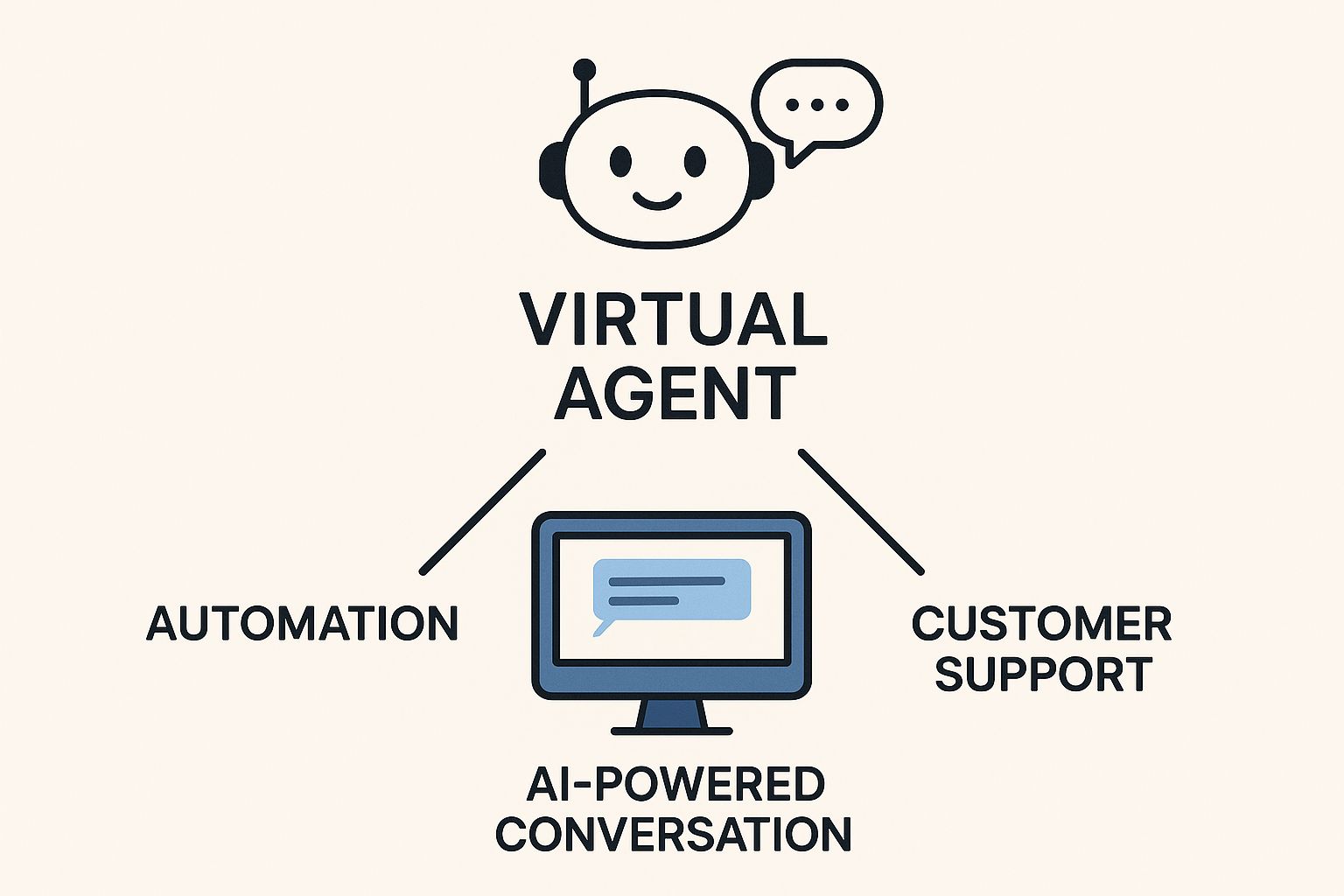
The infographic shows how a virtual agent acts as a bridge between complex AI systems and the way we naturally communicate, making technology more accessible and less intimidating. For a deeper dive into how this plays out in a business setting, check out this helpful guide on how to automate customer support.
Beyond Simple Keywords: Understanding Context
These virtual agents don't just process information; they store knowledge and make decisions in real-time. They can even remember past interactions, understand follow-up questions, and provide personalized responses. Imagine having a conversation with someone who remembers everything you've ever told them and uses that information to help you better – that’s the potential of a well-trained virtual agent.
The following screenshot from the Wikipedia page on Natural Language Processing reveals the many layers involved in NLP, a critical component of how a virtual agent "thinks":
This image highlights the complexity of NLP and shows how it breaks down human language into smaller parts so machines can understand meaning and context. This is how virtual agents go beyond simply recognizing keywords; they actually strive for comprehension.
Let's dive a little deeper into the specific technologies that enable this impressive ability. The table below compares some of the key AI technologies powering virtual agents:
Virtual Agent Technologies Comparison
| Technology | Primary Function | Complexity Level | Common Applications |
|---|---|---|---|
| Natural Language Processing (NLP) | Understanding and interpreting human language | High | Sentiment analysis, chatbots, machine translation |
| Machine Learning (ML) | Learning from data to improve performance | Medium to High | Predictive modeling, personalization, fraud detection |
| Deep Learning (DL) | Advanced form of ML using artificial neural networks | High | Image recognition, natural language generation, complex pattern recognition |
| Knowledge Representation and Reasoning (KRR) | Storing and retrieving information to answer questions | Medium | Expert systems, question-answering systems |
This table gives a quick overview of how different AI technologies contribute to the "thinking" process of a virtual agent. From understanding language to learning from experience, each technology plays a vital role.
With every interaction, these agents become smarter, more efficient, and more helpful. Through clear explanations and helpful comparisons, we aim to demystify the technology that enables virtual agents to engage in human-like conversations so effectively.
Real-World Applications That Actually Matter
Virtual agents aren't some futuristic fantasy; they're actively reshaping how businesses operate today. Imagine having customer service available around the clock or a sales assistant who remembers every single customer interaction. These scenarios are becoming increasingly common across various industries, changing how we interact with products and services. Let's explore some compelling real-world examples of virtual agents handling everything from technical troubleshooting to sensitive healthcare inquiries.

This screenshot from Salesforce shows how virtual agents, often called chatbots, are integrated into customer service platforms. Notice the clean interface and the emphasis on easy communication. This type of integration helps businesses offer immediate support and boost customer satisfaction.
Revolutionizing Customer Service
Virtual agents are revolutionizing customer service by offering instant, accurate information. This frees up human agents to handle more complex issues.
Think about the retail industry. Virtual agents can guide customers through purchases, answer product questions, and even offer personalized recommendations. This enhances the shopping experience and can lead to higher sales conversion rates.
In healthcare, virtual agents can streamline appointment scheduling, handle FAQs, and give basic medical information. This allows healthcare professionals to dedicate more time to direct patient care, improving both efficiency and patient satisfaction.
Financial Institutions and Beyond
Financial institutions are using virtual agents to deal with routine questions, process transactions, and provide secure access to account information. This reduces wait times and significantly improves the customer experience.
For example, a virtual agent can guide a customer through resetting a password or checking their balance. This provides immediate support and frees up human agents for more demanding tasks.
For even more examples of conversational AI in action across different sectors, check out these conversational AI examples.
To better illustrate the versatility of virtual agents, let's look at a table summarizing various use cases by industry:
To illustrate the breadth of applications, let's examine some specific industry use cases and the associated benefits:
Virtual Agent Use Cases by Industry
| Industry | Primary Use Case | Key Benefits | Implementation Complexity |
|---|---|---|---|
| Retail | Product information and order tracking | Increased sales conversions, reduced customer service costs | Low |
| Healthcare | Appointment scheduling and basic medical information | Improved patient satisfaction, freed-up healthcare professionals | Medium |
| Finance | Account balance inquiries and transaction processing | Enhanced security, reduced wait times | Medium |
| Telecommunications | Troubleshooting and technical support | 24/7 availability, faster resolution times | Low |
| Travel | Booking assistance and itinerary management | Personalized travel recommendations, improved customer experience | Medium |
This table provides a snapshot of how various industries are using virtual agents to enhance their operations and customer interactions. The implementation complexity varies depending on the specific use case and integration requirements. However, the consistent theme is improved efficiency and a better customer experience. Each application highlights how these tools are contributing to better operational efficiency and higher customer satisfaction.
Government Innovation With Virtual Agents
Imagine trying to explain a complicated issue to a friend. That's the role virtual agents are increasingly playing within government services. They're designed to simplify complex processes, making public services easier to access and more efficient. Think of the last time you wrestled with government bureaucracy – virtual agents are designed to make those interactions smoother.
These AI-powered assistants can help citizens navigate everything from complicated tax procedures to applying for permits, ultimately streamlining interactions and reducing wait times. It’s all about making government services more user-friendly.

This screenshot showcases the mObywatel app, Poland's official digital document platform. The clean design highlights the importance of user-friendliness, a critical factor for government services aiming for widespread adoption. This emphasis on accessibility encourages citizens to use digital government platforms. Poland is actively embracing this technology, with a proposal in April 2025 to integrate a virtual assistant into mObywatel. Learn more about AI developments in Poland.
Unique Challenges and Opportunities
Integrating virtual agents into government isn't without its challenges. There are specific hurdles to overcome. Consider the stringent privacy regulations, security concerns, and the need to cater to diverse populations with varying tech skills. These all require careful planning and execution.
Successfully implementing virtual agents in the public sector requires finding the right balance between leveraging technology and meeting the unique needs of a diverse citizenry.
Setting New Standards for Digital Governance
Despite the challenges, successful implementations of virtual agents are reshaping how government services operate. They are setting a new benchmark for citizen engagement. These initiatives are making government more responsive and accessible to everyone.
This progress highlights the potential of virtual agents to create a more user-friendly and efficient public sector. By carefully addressing the specific requirements and obstacles faced by government agencies, these AI tools can fundamentally improve how citizens interact with public services.
The Business Benefits That Drive Real Results
So, why are so many companies looking into virtual agents? It boils down to seeing real improvements in their businesses. These digital helpers aren't just a futuristic concept; they're delivering practical benefits every day, impacting things like cost, efficiency, and how happy customers are. We're talking about tangible changes that affect the bottom line.
Think about it: virtual agents can handle tons of conversations at once, all while providing the same level of service. No more long hold times for customers! Plus, they work 24/7, meaning your business is always available. This frees up your human employees from dealing with repetitive questions, allowing them to focus on the more complex issues that require a human touch.
Quantifiable Impact on Business Operations
We don't have to guess about the impact of virtual agents. Real-world data shows they can genuinely improve how well a company keeps its customers, how quickly it responds to inquiries, and even how many sales it makes. These aren't just theoretical improvements, they're demonstrable results.
Take a look at this screenshot from the IBM Watson Assistant page:
This illustrates a crucial advantage: virtual agents can access and process information incredibly quickly. This leads to faster, more effective customer service, making customers happier and reducing the workload on human agents. If you're interested in learning more, check out this article on AI chatbots.
Empowering Human Employees
Now, let's talk about the human side of things. Virtual agents aren't about replacing people; they're about helping them. By handling routine tasks, virtual agents create opportunities for employees to take on more interesting and strategic roles.
This shift leads to greater job satisfaction and allows businesses to make the most of their employees' talents. It's a collaborative approach where technology empowers people to contribute in more strategic ways, fostering a more engaging and fulfilling work environment for everyone.
Implementation Strategies That Actually Work
Successfully launching a virtual agent isn't just about picking the right software. It takes planning, much like building a house. You wouldn't start without blueprints, would you? This section walks you through the strategies that separate successful virtual agent deployments from expensive flops.
Defining Clear Objectives and Gathering Quality Data
First, pinpoint exactly what problems your virtual agent will solve. Will it handle customer questions, book appointments, or qualify leads? A clear vision keeps your project focused. Next, collect good training data. This data is how your virtual agent learns to understand and respond to users. Think of it as the curriculum for a digital student.
Microsoft Azure offers a platform for creating AI-powered chatbots, a core part of virtual agent technology. Check out the Azure Bot Service interface:
The screenshot shows how easy it is to build and manage bots within Azure. A user-friendly interface is key when building and deploying virtual agents.
Seamless Integration and User Experience Design
For your virtual agent to really perform, it needs to work with your existing systems. Connect it to your CRM, website, and other relevant platforms. This creates a smooth, unified customer experience. Finally, focus on user experience design. The easier your virtual agent is to use, the more people will use it. A positive user experience encourages adoption and delivers real value. For a deeper dive, check out our guide on implementing chatbots.
Measuring Success and Continuous Improvement
Don't just track simple metrics like response times. Get user feedback to pinpoint areas for improvement. Your virtual agent isn't static; it's an evolving tool. Regularly refine its performance based on how users interact with it and how your business needs change. This ongoing optimization ensures your virtual agent stays effective and delivers real results. By following these strategies, you’ll maximize your virtual agent's potential and achieve meaningful business outcomes.
What's Coming Next For Virtual Agents
Virtual agents are changing fast. To make smart choices today, it's helpful to understand what's on the horizon. This section explores exciting new capabilities that promise to make virtual agents even more powerful and adaptable.
Imagine a virtual agent that picks up on the subtle stress in a customer's voice and responds with empathy. Or picture smooth, natural interactions blending text, voice, and visuals for a richer communication experience. These aren't just fantasies; these advancements are coming soon.
This screenshot from the OpenAI ChatGPT blog shows a conversation with the AI model. The simple interface highlights the growing focus on user-friendly design in AI tools, making them accessible to everyone. This demonstrates the real progress being made in creating conversational AI that feels natural and intuitive.
Personalization, Context, and Sophistication
Virtual agents are getting much better at personalization, tailoring interactions to each customer's history and preferences. Think of it like a helpful shopkeeper who remembers your usual order. They're also improving at understanding context, recalling past conversations to provide more relevant and helpful answers. And they're tackling more complex tasks, going beyond basic FAQs to handle tricky troubleshooting and problem-solving.
Ethical Considerations and the Human-AI Partnership
As virtual agents grow more advanced, we need to think about the ethical side of AI. Data privacy, security, and responsible AI development are key concerns. It's also important to understand the changing relationship between humans and AI. Virtual agents aren't here to replace human workers; they're designed to boost their abilities, freeing them to focus on more strategic and creative work. Think of it as giving employees a powerful new tool, not showing them the door.
This forward-looking approach helps us prepare for the next generation of virtual agent technology. These tools will change how we work and interact with digital services in the coming years. Ready to improve your customer communications? Explore the power of Voicetta, the innovative AI communication platform, and see how it can transform your business.
Was this useful?
If this article helped, add Voicetta as a preferred source in Google Search. Your results can then highlight our writing.
Add as preferred source